The Marguerite Young Society
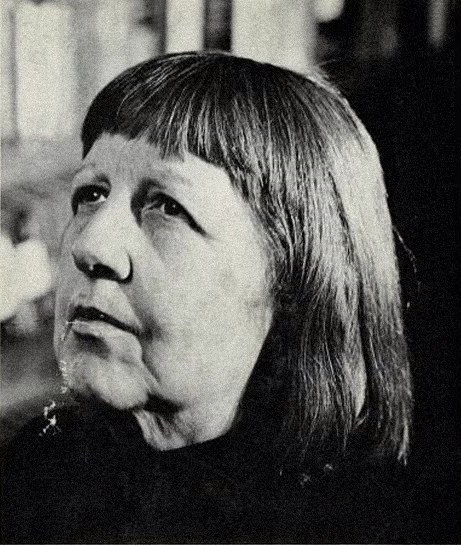
A home for the work of Marguerite Young (1908 to 1995): her novel, her history, her essays and her poems.
Read it anywhere. This site can be installed on a phone, tablet, or computer like an app, and whole books can be saved to read without a connection. Install the App
Her works
- Miss MacIntosh, My Darling: her novel, 1965
- Angel in the Forest: two failed utopias in New Harmony, Indiana, 1945
- Harp Song for a Radical: the life and times of Eugene Victor Debs, 1999
- Inviting the Muses: stories, essays and reviews, 1994
- The Collected Poems of Marguerite Young: every surviving poem, 2022
Her philosophy
More About Young
- Psychology in Young's Works: how her writing takes up the mind
- Politics in Young's Works: power, utopia, labor and the people at the margins
- Marguerite Young, Our Darling: tributes and essays, 1994
- Young's Interviews Analyzed: what she said about her work and life
Who Was Marguerite Young? The Life Behind the Longest Great American Novel
The life of Marguerite Young, the Indiana-born author of Miss MacIntosh, My Darling: her utopias, her Greenwich Village years, and the novel that took her eighteen years to write.
Most people have never heard her name, so if you haven’t, that is no surprise. Marguerite Young wrote one of the most ambitious American novels of the twentieth century, kept company with some of the most famous writers of her era, and spent nearly fifty years as a fixture of Greenwich Village. And still she sits just outside the edge of the canon most readers are handed. This Society exists to fix this error in American literature, philosophy, psychology, and politics.
An Indiana childhood
Marguerite Young was born in Indianapolis, Indiana, in 1908. Her parents separated when she was small, and she and her younger sister were raised largely by their grandmother, a woman who painted and wrote poems of her own. From her, Young got an early and lasting sense that the imagination was a real place, somewhere a person could actually live.
She was a literary child in the most committed way. She was writing poems as a girl and publishing them young. She earned degrees from Butler University and the University of Chicago and did further graduate study, and for a while she taught high school English back in Indianapolis. Her first two books were collections of poetry, published while she was still teaching.
The town of failed utopias
In the late 1930s she visited New Harmony, Indiana, a small town that had once been the site of two nineteenth-century attempts to build a perfect society. Both had failed. Something about the place held her, and she moved there and stayed for years.
Out of that time came her first major book, Angel in the Forest: A Fairy Tale of Two Utopias, published in 1945. It braids history and imagination together into a study of people who tried to build heaven on earth and the ways their dreams came apart in their hands. It won her a Guggenheim Fellowship and real acclaim. The subject would stay with her for the rest of her life: the beautiful and doomed human habit of trying to perfect the world, and what that trying costs the people who attempt it.
Greenwich Village and the company she kept
By the 1940s Young had moved to New York and settled in Greenwich Village, where she would remain for most of her life. She became one of those legendary neighborhood figures, an eccentric known on sight, talking in the same lush, looping way she wrote.
Her circle was remarkable. Anaïs Nin championed her work. She knew Truman Capote and Carson McCullers and moved through the city’s literary scene for decades. She taught for years at the New School for Social Research, and a long line of younger writers came through her classroom and remembered her, for the rest of their lives, as the mentor who took them seriously.
The novel that took eighteen years
Somewhere in her early New York years she began the book that would come to define her. She thought Miss MacIntosh, My Darling would take about two years. It took eighteen. She worked at it daily, and the manuscript grew to nearly 1,200 pages, built out of long looping sentences and dream logic and a narrator riding a bus across the Midwest in search of a lost nursemaid.
When Scribner published it in 1965, many mainstream critics did not know what to do with a novel that size and that strange, and a good number of them dismissed it. But it found a devoted following that has never entirely faded, and it has since been called, only half as a joke, the longest great American novel almost nobody has read. If you want to meet the book itself, there is a full reading guide on this site to walk in with you.
One more enormous labor
Young was not finished with impossible projects. For the last long stretch of her life she worked on a sprawling biography of Eugene Debs, the labor leader and five-time candidate for president, a man whose fierce and unfashionable idealism clearly spoke to her. She did not live to complete it. It was published after her death as Harp Song for a Radical: The Life and Times of Eugene Victor Debs.
It fits everything else she cared about. Dreamers, radicals, and the long American argument about how we ought to live together: these were her lifelong subjects, whether she was writing about a failed utopia in Indiana, a hallucinating mother in a house by the sea, or a socialist who ran for office from a prison cell.
Her death, and her slow return
Marguerite Young died in 1995, at eighty-seven. For years afterward she was mostly a rumor, a name traded quietly among people who love difficult books. That has been changing. Her novel is back in print through the Dalkey Archive, new readers keep finding their way to her or returning to her. This Society makes the case that she was doing something well ahead of her time before philosophy even had the words to talk about what she accomplished.
Part of why this Society exists is a conviction that Young was not only a stylist but a thinker. Underneath the enormous sentences is a coherent way of seeing the self, memory, grief, and power, one I explore here under the name Radical Immanence. She built it quietly, decades before the culture had the words to receive it.
Reviews of Marguerite Young’s Work
Marguerite Young’s books have always divided critics. Some reviewers called her a genius and set her beside Melville and Joyce, while others gave up partway through or complained that her prose was too rich to follow. What follows gathers the major reviews of each book, from the first notices to the most recent reissues, so readers can see how her reputation has moved over eighty years.
Angel in the Forest (1945)
Young’s history of the two failed utopias at New Harmony, Indiana, was well received when it appeared and won her a Guggenheim Fellowship and a Newberry Library award. Martin Lebowitz, writing in The Nation in May 1945, found the book repetitive and overwritten in places but still judged it “a genuine work of art.” Marianne Hauser took up the book in the Sewanee Review in the spring of 1946.
When the book was reprinted in 1966, Harriet Zinnes returned to it in The Nation. She praised the original as superb and wondered whether readers of the 1960s, grown suspicious of dreamers, could take it in without irony.
The book found a new champion in Chad W. Post, publisher of Dalkey Archive Press, who wrote about it in October 2024 when Dalkey reissued it as one of its Essentials. He called it a fascinating and compelling book, driven by Young’s prose and by the strength of her material, and argued that its theme of abandoned utopias still works because readers can still believe utopia is possible.
Miss MacIntosh, My Darling (1965)
No book of Young’s drew stronger reactions in either direction. William Goyen, reviewing it on the front of the New York Times Book Review on September 12, 1965, compared it to Joyce, Broch, Melville and Faulkner and called it “a work of stunning magnitude and beauty.” Howell Pearre of the Nashville Banner went further, calling Young a genius and naming the novel the most important work in American literature since Moby-Dick.
Other reviewers were impressed and uneasy at once. Richard Ellmann, in the New York Herald Tribune, found the novel “an extraordinary cosmos” that was ambitious beyond what it could fulfill. Melvin Maddocks of the Christian Science Monitor ranked it with Ulysses and The Waves as an innovative novel, yet worried that Young may have written a book that, in the deepest sense, does not exist. Granville Hicks admired the recurring symbols and the hypnotic language but faulted the lack of fixed points, which left it unclear whose dream was whose. J. M. Edelstein, in The New Republic, read the tension between reality and dream as the book’s center and judged its obscure patterns an obstacle to its art.
Some critics simply could not finish. Peter Prescott later admitted that he quit after two days, even though his editor had offered him four times the usual rate. In England, Elizabeth Harvey of the Birmingham Post asked whether the novel’s length was substance or only size, though she admired Young’s stamina and found rewarding pockets of wit.
Writers who loved the book defended it fiercely. Anaïs Nin reviewed it for the Los Angeles Times in January 1966 under the title “One writer’s version of a complete universe,” and the piece later became the introduction to the 1979 paperback. Marianne Hauser, in the Sewanee Review in 1967, called it “masterful, exhilarating.” Anne Tyler later said that reading random pages of the novel cured her writer’s block while she was working on The Accidental Tourist.
The novel’s later critics have tended to treat it as a lost masterpiece. Steven Shaviro, writing in 1990, argued that its strength lies in refusing to fit either modernism or postmodernism. Gregory Feeley wrote about the 1994 Dalkey Archive reissue in the Washington Post Book World, and Kenneth King asked in the Antioch Review in 2016 whether it was a “Forgotten Masterpiece?” Meghan O’Gieblyn, writing in the Paris Review in 2018, found it slow going but argued that “the problem is not the book’s length but its ambition.” Her essay now introduces the Dalkey Archive edition. Ryan Ruby’s 2023 essay in The New Yorker named it “The Longest, Least-Remembered Great American Novel,” and Andie Blaine of Air Mail recommended the 2024 reissue in July of that year as best read about ten pages at a time before bed.
Inviting the Muses: Stories, Essays, Reviews (1994)
This collection of Young’s shorter work includes three stories, one of them previously unpublished, fifteen essays, twenty-three book reviews, and portraits of Johnny Gruelle, creator of Raggedy Ann, and the poet Marianne Moore. Publishers Weekly noted her admiration for writers who use symbolism and mysticism, such as Truman Capote and Doris Lessing, and her sharp quarrel with Sartre’s view of a meaningless life. The review predicted that her devotees “will welcome this collection of her early writings.”
Harp Song for a Radical: The Life and Times of Eugene Victor Debs (1999)
Young’s unfinished life of Debs, edited after her death by Charles Ruas and published by Knopf, split reviewers much as her novel had. Publishers Weekly, in July 1999, called it prodigious but not a traditional biography, and said its prose was “so purple it often clots the narrative flow.” Kai Bird, writing in Civilization, found the style chaotic and often hard to fathom but praised its vision of Debs as an American prophet.
Steven Moore, in the Washington Post in September 1999, was the book’s warmest reviewer. He called it fabulous and complained only that it was not long enough. Russell Baker reviewed it in the New York Review of Books under the title “Only in America,” and John Leonard took it up in The Nation as “Mr. Debs, My Darling,” a nod to the novel. Rick Levin wrote about it in The Stranger in January 2000 as “The Spinning Head of History.”
The Collected Poems of Marguerite Young (2022)
The first full gathering of Young’s poetry, edited by Phil Bevis, Joshua Rothes and Jacob Siefring, brought her earliest work back into view. Steven Moore reviewed it for the Poetry Foundation in October 2022 and praised it as an edition that rivals the work of a university press. He found the early poems uneven but called Prismatic Ground an impressive debut, and he argued that the poems are the root of her prose. His verdict on the whole was simple: “It was worth the wait.”
Alex Lanz, writing on his Substack Silent Friends in January 2023, admired the poems’ epic, Miltonic style and their engagement with Kant and Berkeley on perception and the limits of knowledge. He described them as “very old and very new” and argued they deserve a wider readership.
Writers Who Admired Her
Some of Young’s strongest admirers were fellow writers, and several of them first knew her as a teacher.
Kurt Vonnegut was one of her students when she taught high school English in Indianapolis, years before either of them was known. He went on to his own fame, and his judgment of his old teacher appeared on the cover of earlier editions of the novel, including Scribner’s two-volume set: Marguerite Young is “unquestionably a genius.”
John Gardner, author of Grendel and The Art of Fiction, studied with Young at the University of Iowa Writers’ Workshop, where she taught from 1954 to 1957. She was a teacher and mentor to him there, one of many young writers she shaped in those years. David O. Dowling’s 2019 history of the Workshop, A Delicate Aggression, gives her a chapter of her own, titled “The Guru.”
Anne Tyler turned to Miss MacIntosh, My Darling when she was stuck while writing The Accidental Tourist. She opened the novel to random pages, and wherever she landed, she later wrote, “a glorious wealth of words swooped out at me.” The reading broke her writer’s block.
Anaïs Nin was her most devoted champion. She persuaded Harcourt Brace Jovanovich to bring the novel out in paperback and wrote the preface for the 1979 edition, where she called the book “a canto to obsession.”
Questions readers ask
Who was Marguerite Young?
Marguerite Young (1908 to 1995) was an American novelist, historian and poet born in Indianapolis, Indiana. She is best known for Miss MacIntosh, My Darling (1965), a novel of nearly 1,200 pages that took her eighteen years to write. She lived most of her life in Greenwich Village and taught at the New School and the Iowa Writers’ Workshop.
What is Miss MacIntosh, My Darling about?
Miss MacIntosh, My Darling follows Vera Cartwheel, who rides a bus across the Midwest searching for Miss MacIntosh, the nursemaid who raised her and vanished. Along the way the novel moves through her mother’s opium dreams in a house by the sea and the lives of the people Vera meets, asking what is real, what is illusion, and whether anyone can truly be known.
How long is Miss MacIntosh, My Darling?
The novel runs to nearly 1,200 pages in 82 chapters. Young expected it to take about two years and spent eighteen. Ryan Ruby’s 2023 essay in The New Yorker called it “The Longest, Least-Remembered Great American Novel.”
Is Miss MacIntosh, My Darling in print?
Yes. Dalkey Archive Press publishes the novel, with an introduction by Meghan O’Gieblyn, and reissued Angel in the Forest in 2024. The Collected Poems of Marguerite Young is published by Chatwin Books. Inviting the Muses is out of print but can be borrowed free at the Internet Archive.
How should a first-time reader approach Miss MacIntosh, My Darling?
Slowly, and without worrying about following every thread. Andie Blaine of Air Mail suggested about ten pages at a time before bed. This site offers a free chapter-by-chapter reading guide, character pages, and audio of the novel read aloud to keep a reader oriented.
What is Radical Immanence?
Radical Immanence is the name Coral Russell gives to the philosophy she finds in Marguerite Young’s work: the view that everything that matters, including the sacred, is found here in ordinary, unfinished human life rather than in a world beyond it. Russell sets it out in Eleven Pillars, among them Not One Self, Grief Doesn’t End, and The Sacred Is Here.
Which famous writers admired Marguerite Young?
Anaïs Nin was her most devoted champion and wrote the preface to the 1979 paperback. Kurt Vonnegut, her former high school student, called her “unquestionably a genius.” John Gardner studied with her at the Iowa Writers’ Workshop, and Anne Tyler said reading random pages of the novel broke her writer’s block.
Buy Marguerite Young’s books
- Miss MacIntosh, My Darling
- Angel in the Forest
- The Collected Poems of Marguerite Young
- Inviting the Muses, out of print, borrow free at the Internet Archive
- Marguerite Young, Our Darling - Out of print
Coral Russell
Coral Russell is a retired teacher with a Master’s in Education, with an emphasis in Reading and English for Speakers of Other Languages (ESOL). She taught ESOL for 15 years, from kindergarten through adult learners, at public and private schools in the US and Korea, as well as virtually in China and Venezuela. She also taught writing at the community college level and served as a director and teacher for adult education through the Ohio state program.
She started exploring Marguerite Young’s work in 2019, after her first reading of Miss MacIntosh, My Darling.
She writes at The Marguerite Young Society on Substack, where she has spent years building one of the most sustained bodies of literary and political commentary happening outside a university. Her focus is the work of novelist Marguerite Young, especially the sprawling 1965 novel Miss MacIntosh, My Darling, which she reads as a philosophical system as much as a story. She is the author of Radical Immanence based on what she believes is Young’s philosophy, and her writing moves between close textual analysis, personal history, and the wider political and psychological questions Young’s work opens up.