The Story in Time
Story Arcs · Chapter Hubs · Start Here
Spoiler note: This page covers the whole novel, including its ending. If you are reading along, use the diagram for orientation and save the table until you finish the book.
Vera tells the novel from a bus journey across the Midwest, but most of its pages are memory, and some are memory inside memory. This page shows how the telling loops and then puts the events in the order they happened.
How the telling loops
The novel opens on the bus and stays there for eight chapters. At Chapter 9 Vera turns back to the night of her fourteenth birthday. From Chapter 24 her memories move into the house, to Mr. Spitzer’s evenings at her mother’s bedside, and from there into his memories of Cousin Hannah and of his own grief. Only at Chapter 63 does the novel return to Miss MacIntosh, for her last month, and only at Chapter 67 does the bus pull up to the tavern.
■ The present: the bus, the tavern, Esther’s diner · ■ Vera’s memories of Miss MacIntosh · ■ The house: Mr. Spitzer and Cousin Hannah
Two threads break off and resume. The bus story stops after Chapter 8 and picks up at Chapter 67, nearly 60 chapters later. Vera’s memories of Miss MacIntosh stop after the birthday breakfast in Chapter 23 and resume at Chapter 63. When the long middle feels endless, it helps to know that both threads are waiting.
The rings as eras of time
The two broken threads are part of a larger pattern. Paired up, the novel’s movements nest inside one another like rings around a staff, the way the arcs ring the column of strings in the music diagrams of Boethius. Each ring is a depth of the past. The outer ring, the bus answered by the tavern, Esther, and the dawn, is the present. The next ring in, the birthday night answered by the last month, is Vera’s fourteenth year. Inside that, Mr. Spitzer’s evenings and his grief reach back before Vera’s memory, and at the center sits Cousin Hannah, whose whole life is the oldest time in the book.
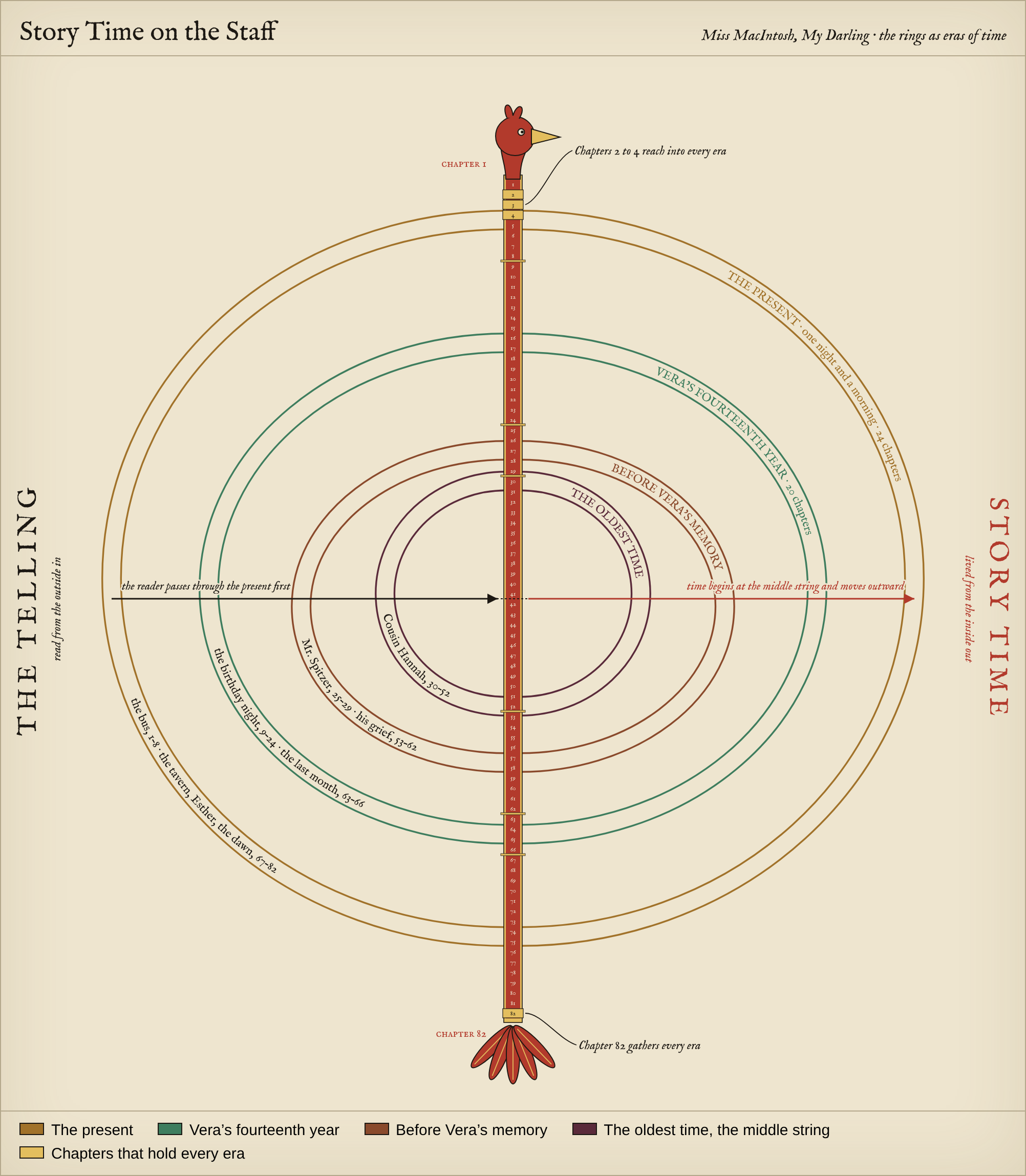
The telling, on the left, runs from the outside in: a reader enters through the present. Story time, on the right, runs from the inside out: the oldest events sit at the middle string. Gold marks the chapters that reach into every era.
So the novel is told from the outside in, and its chronology runs from the inside out. Vera vanishes from Chapters 23 to 65, the chapters set before or beyond her own memory. Only the head and tail break the pattern: Chapters 2 to 4 sketch the house, foretell Miss MacIntosh’s walk into the sea, and leap ahead to Vera’s grief, while Chapter 82 gathers the storm, Catherine’s death, and the three deaths Vera mourns. Every character’s place on the same staff is drawn in All the Darlings.
Events in the order they happened
Young rarely gives dates or ages, and the table only states what the novel makes clear. Vera’s age is stated only for the birthday night, but she says the last month came after she had seen Miss MacIntosh’s secret, with autumn just beginning, so she is still about fourteen when Miss MacIntosh disappears. Where the novel leaves the order open, the table says so.
| When | What happens | Told in chapters | Vera’s age |
|---|---|---|---|
| The older generation | Vera’s grandfather plants a garden for his blind wife; the black coachman drives his carriage behind four white horses. | 12, 14 | Before Vera’s memories begin |
| The older generation | The Spitzer twins take opposite mottos: Peron seizes the day, Joachim keeps to his work. Peron gambles, borrows, and forges his brother’s checks. | 2, 53, 55 | Before Vera’s memories begin |
| The older generation | Catherine loves Peron, who does not love her, while Joachim loves Catherine. She marries Jock Cartwheel; Cousin Hannah tries to break up the wedding. Jock later vanishes while mountain climbing. | 2, 30, 32 | Before Vera’s memories begin |
| The older generation | Peron falls from a fourteenth-floor window. Joachim pays for the funeral and the debts, goes bankrupt, and begins living in his brother’s shadow. | 14, 25, 55, 56 | The novel does not fix the year |
| The older generation | Cousin Hannah’s suffrage career and her secret life. She dies with Mr. Spitzer at her bedside, and he finds her trunks of wedding gowns. | 30 to 52 | Before the novel’s present |
| Miss MacIntosh’s past | Her bald childhood in What Cheer, Iowa; her years caring for orphans and the blind; her love for Lorena; her engagement to Mr. Bonebreaker, who flees. | 64, 65 | Before she comes to the house |
| Vera’s childhood | Catherine takes to her bed with opium. Mr. Spitzer hires Miss MacIntosh to raise Vera, and the lessons, proverbs, and Solomon the turtle fill the schoolroom. | 2, 3, 9, 12 | Childhood |
| Vera’s childhood | The night of Vera’s fourteenth birthday: the empty party, the gardens, the sea, the ride on Falada, the bald Miss MacIntosh, the long night. | 9 to 20 | 14 |
| Vera’s childhood | The morning after: the tidy room, the ruined dress, the festive breakfast, Miss MacIntosh’s tirade against light. | 21 to 23 | 14 |
| The last month | Soon after the birthday night, as autumn begins, Miss MacIntosh takes off her wig and tells Vera her life story. | 63 to 65 | About 14 |
| The last month | One cold September morning, Miss MacIntosh walks into the sea. Her clothes are found on the beach and her red wig is torn in the sand. | 3, 66 | About 14 |
| After | Vera grieves by the shore for years. Catherine offers her opium; Vera refuses and sets out for What Cheer. | 4 | Grown |
| After | Mrs. Hogden’s stay in the abandoned playroom. Vera admits she never saw her, so this story comes to her secondhand. | 70 | Timing unclear |
| The present | The Grey Goose bus crosses the flooded Midwest toward Indiana. | 1, 5 to 8, 67 | Grown |
| The present | A night at the Tavern, with Mr. Weed and Dr. O’Leary through the wall. | 68 to 71 | Grown |
| The present | A morning, or many mornings, listening to Esther Longtree. Her own stories reach back to her stillborn twin, her childhood, and Walter. | 72 to 81 | Grown |
| The present | Vera thinks of the storm that swept away the house, her mother’s death in Mr. Spitzer’s arms, and the three deaths she mourns. At dawn she meets the stone deaf man. | 82 | Grown |
Clues to the period
- Moses rails against the Democrats and the New Deal (Chapter 5), which began in 1933.
- Mr. Spitzer mourns Martha, the last passenger pigeon, who died in 1918 (Chapter 49).
- Miss MacIntosh repeats the story of men jumping from windows after the 1929 crash (Chapter 66).
- Esther hopes a coming war will make old murders seem small (Chapter 75).
Together these place the bus journey in the 1930s, with the world heading toward war, though Young never names a year.
Cite this page: Russell, Coral. “The Story in Time.” The Marguerite Young Society, updated October 29, 2026. https://marguerite-young-society.coralrussellbooks.workers.dev/story-in-time