Young's Interviews Analyzed
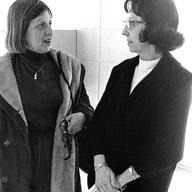
← Marguerite Young, Our Darling · The Marguerite Young Society
Young talked about her work at length in interviews, and the study books lean on them often: the Dalkey Archive interview with Miriam Fuchs and Ellen G. Friedman, the Roy Newquist interview and the Charles Ruas interview among them. This section gathers close readings of what she said about her method, her novel and her life.
Two interviews with Young appear in Marguerite Young, Our Darling.
Where it comes up in the study books
Study materials
- Marguerite Young, Our Darling, Part 7: the 1988 interview with Ellen G. Friedman and Miriam Fuchs and a brief conversation with Fuchs, read closely
Interviews and talks
- The Studs Terkel Interview, 1965 (two-part radio program)
- The Duncan MacDonald Interview, "Observation Point," September 1965
- A Talk on "Angel in the Forest" (the mid-1960s reissue)
- "The Art of Fiction No. 66," Paris Review, Fall 1977 (interviewer Charles Ruas)
- The Ruas and Schwartz Interview on "Angel in the Forest," WBAI (undated)
- The Ruas Interview on Her Life and Miss MacIntosh, WBAI (undated)
- The American Audio Prose Library Interview, New York, May 1983
- The Complete Charles Ruas Interview, "Conversations with American Writers" (1985)
- "A Conversation with Marguerite Young," by Ellen G. Friedman and Miriam Fuchs (Review of Contemporary Fiction)
- The WNYC Interview (undated, the out-of-print years)
Essays, profiles and records
- "Liquescence as Form," a feminist-critical essay by Miriam Fuchs
- "Exorbitance and Death," a critical essay by Steven Shaviro
- "The Guru," a chapter by David O. Dowling on her Iowa years
- "Where the Landscape Moved Like Waves," a late-life profile by Susan Neville
- "Remembering Marguerite Young," a memoir by Steven Moore (Dalkey Days)
- Martha J. Sattler's Chronology (Marguerite Young, Our Darling)
Literary Influences Marguerite Young Named in Her Interviews
Interviews used
- Ruas: Charles Ruas, WBAI
- Ruas, New Harmony: Charles Ruas and Joan Schwartz, WBAI, on Angel in the Forest
- Angel talk: Young’s talk on the reissue of Angel in the Forest
- Terkel: the “ST with MY” interview
- MacDonald: Duncan MacDonald, Observation Point, 1965
- WNYC: WNYC interview, part 1
- Callison 1 and 2: Kay Callison, American Audio Prose Library, 1983
- Friedman and Fuchs: Review of Contemporary Fiction
- Paris Review: The Art of Fiction, 1977
The Influences She Returned to Most
William James. This is the influence she named most often. She studied his psychology “as if it were a Bible” and taught it to her students. She took from him the stream of consciousness, the many selves under one roof, false memory, and “the person you did not become.” She also credits him with her pluralism, seeing the many rather than the one, and with the idea that a person is body, soul, and clothing. (Ruas, Callison 1, Callison 2, Terkel, MacDonald, Friedman and Fuchs)
Saint Augustine. She named The City of God and the Confessions again and again, saying she learned a great deal from their imagery and from his obsession with dreams. When asked about Joyce, she answered that she was influenced by Augustine instead. (Callison 1, Callison 2, Terkel, Friedman and Fuchs)
Herman Melville. She called Moby-Dick her favorite American novel and Melville “my great love,” and said she was “insane about Melville.” She saw in Moby-Dick the same pull between Scottish Calvinism and the longing for Catholicism that she found in her own work. She also liked that she lived near his birthplace. (Terkel, Callison 2, WNYC)
Charles Dickens. She read him by age ten or eleven, introduced by her grandmother. From Dickens she took the rule that every minor character must be fully alive, and the habit of showing a character’s inner life through the outside: body and clothing. She learned shorthand as a teenager because Dickens had. (Ruas, Callison 1, MacDonald, Terkel, Friedman and Fuchs, Paris Review)
Nikolai Gogol. She said she was “deeply under the spell” of Dead Souls, both for its attention to minor characters and for its form as a novel of the road, meeting people who are never seen again. (Ruas, Callison 1, Friedman and Fuchs)
Laurence Sterne. She named Tristram Shandy as a book that directly influenced her, called Sterne a writer she felt close to, and pointed to him when explaining her long sentences. (Ruas, Callison 1, Terkel, Friedman and Fuchs)
Cervantes. She called Don Quixote “the greatest of all novels” and placed Miss MacIntosh, My Darling in the tradition of the picaresque psychological novel. She noted that she mentions Don Quixote on the novel’s first page as a key to the journey ahead. (Callison 1, Terkel, Friedman and Fuchs)
Robert Browning. She studied all of Browning, including The Ring and the Book, at about eighteen with an older teacher, Katharine Merrill Graydon, in Indianapolis. Her belief that a writer should base characters on real events came from Browning’s idea that the poet is a reporter. (Ruas, Callison 1)
Thomas Carlyle. She said she took Carlyle as her master when she moved from poetry to prose. She also named Sartor Resartus among the books that shaped her and made a point of visiting his house in London. (Angel talk, Callison 1, Callison 2)
Samuel Taylor Coleridge. She called the albatross and guilt of The Rime of the Ancient Mariner “the secret heart” of her novel, and said the opium lady faces Coleridge’s final choice. Coleridge’s debate with Robert Owen was part of what drew her to the subject of Angel in the Forest. She even wrote to President Kennedy about nuclear testing using only the imagery of the Ancient Mariner. (Terkel, Angel talk, Ruas, New Harmony, Callison 1)
The Bible. Her grandmother had her read the Bible for its literary style as training for a writer, and Young said she still thought it the best training there is. She also named the Lives of the Saints and urged her students to read them. (WNYC, Terkel, Callison 1, Friedman and Fuchs)
Plutarch’s Lives. She called this “one of the most important books” for her. (Callison 1)
Reading That Shaped Particular Books and Ideas
John Milton. Paradise Lost and the Fall of Man was her major subject at the University of Chicago. She said Milton’s blindness was one reason she became fascinated by people missing a sense, like the stone-deaf man and the blind pianist in her novel. (Callison 1, Terkel)
John Lyly’s Euphues, Heraclitus, and the bestiaries. Her master’s thesis was on the birds and beasts in Lyly’s Euphues, and she said she studied animal symbolism “from Heraclitus onward.” She loved the old bestiaries because animals work as icons for saying things about people. (Ruas, Callison 1, Paris Review)
Fyodor Dostoevsky. She took one idea from him as a key from the very beginning of Miss MacIntosh: that sleepers divided by day all dream the same dreams at night, so our dreams bind us, not our reasons. (Terkel)
Walt Whitman. She described Miss MacIntosh, My Darling as “a sad Walt Whitman,” built on his theme of the one and the many. (Terkel, Callison 1)
Carl Jung. She said she read Jung “to give me courage along the way” and would call her novel Jungian rather than Joycean or Faulknerian. (Terkel)
Daniel Defoe. She thought of Miss MacIntosh as a kind of Robinson Crusoe with her umbrella, a Calvinist figure set down in a Miltonic or Dantean paradise. (Terkel)
Elizabeth Barrett Browning and Thomas De Quincey. She had already read Barrett Browning and De Quincey’s Confessions of an English Opium-Eater before meeting the real opium lady, and both shaped how she understood her. (Ruas, MacDonald, Callison 1)
Ralph Waldo Emerson and the Transcendentalists. She set the opium lady’s house near Boston because it was the home of “my beloved Emerson.” She also named Blake, Swedenborg, and Transcendentalism as the kind of philosophy American writing grows from. (MacDonald, Callison 2)
Edgar Lee Masters and Thomas Gray. While writing Angel in the Forest she thought a great deal about Spoon River Anthology and Gray’s “Elegy Written in a Country Churchyard.” She had not yet read Sherwood Anderson. (Ruas, New Harmony)
Joseph Smith and the Mormons. She said she was more influenced by the poetry of the Mormons than by T. S. Eliot, and that she loved Joseph Smith as the more poetic partner to Brigham Young. (Friedman and Fuchs, Ruas)
Charles Darwin, Audubon, and Rachel Carson. The opium lady, Minna Weissenbach, urged her to read Darwin’s Voyage of the Beagle, and Young kept notebooks of her nature reading. She also named Audubon and Rachel Carson. (WNYC, Ruas)
The epic tradition. At Chicago she studied the same sources Eliot drew on, including Dante, Milton, Lucretius, Locke, Fourier, Darwin, and Owen. (Friedman and Fuchs)
Teachers and Early Guides
Her grandmother. Young called her grandmother the great influence of her life and felt her presence while writing. Leon Edel told her Miss MacIntosh was “a grandmother’s book.” Her grandmother introduced her to Anatole France, Dickens, George Eliot’s Adam Bede, Victor Hugo, Blake, and Thomas Moore, and read metaphor as plain truth. (MacDonald, Ruas, Callison 1, Paris Review)
Anatole France. Through her grandmother he became the writer she loved most as a girl, and she read all of him in French. (Ruas, Paris Review)
Robert Morss Lovett and Ronald S. Crane. She named these University of Chicago professors as direct influences. Lovett taught her epic literature. In Crane’s class she read Tom Jones thirteen times to study its structure, which she called the most valuable training for her own writing. (Friedman and Fuchs)
Stith Thompson. She admired the ballad scholar and dreamed of collecting Scottish ballads in the Tennessee mountains. (Ruas, New Harmony)
Writers She Loved Without Imitating
She named these as writers she loved or admired while making clear their style was not hers:
- Mark Twain, for his dark cosmic spirit (Ruas)
- Theodore Dreiser and Sinclair Lewis, as great dreamers from the Midwest. Lewis once told her she had shown “another America.” (Ruas, Friedman and Fuchs)
- Edgar Allan Poe, whom she said she could almost see at Sheridan Square on rainy nights (Callison 2, Friedman and Fuchs)
- Dylan Thomas, whom she felt closer to than Henry James (Callison 2, Friedman and Fuchs)
- Henry James, who visited her in dreams while she wrote Miss MacIntosh, though she did not consider her writing Jamesian (Callison 1, Callison 2)
- Elinor Wylie, whom she preferred to Edna St. Vincent Millay (WNYC)
- Victor Hugo, W. H. Auden, William Carlos Williams, Wallace Stevens, James Merrill, Ambrose Bierce, and Vachel Lindsay (Friedman and Fuchs)
- Women writers she considered great: Kay Boyle, Christina Stead, Katherine Anne Porter, Katherine Mansfield, Anna Kavan, and Jane Bowles (Friedman and Fuchs)
- Later writers: Flannery O’Connor, Toni Morrison, and Cynthia Ozick, whom she thought was also influenced by William James (Callison 2, Friedman and Fuchs)
Influences From Outside Literature
Charlie Chaplin. She said Chaplin “influenced every book I’ve ever written,” through his mimicry. (Callison 2)
W. C. Fields, Marc Chagall, and Ethel Barrymore. She based the passive policeman on Fields, said Chagall influenced Esther Longtree, and said Barrymore shaped the way Miss MacIntosh walked. (Callison 2)
Writers She Said Did Not Influence Her
Gertrude Stein. She knew and liked Stein but felt no kinship with her as a writer. (Ruas, Friedman and Fuchs)
T. S. Eliot. She admired Eliot but resented readers who heard echoes of him, saying she went to his sources rather than to him. (Friedman and Fuchs, MacDonald)
James Joyce. She loved his work but told Friedman and Fuchs he did not influence her. In the 1983 Callison interview, however, she said she related herself more closely to Sterne and Joyce than to Henry James. (Friedman and Fuchs, Callison 1)
Virginia Woolf. She rejected the comparison, though she based Miss MacIntosh’s walk into the sea partly on Woolf’s death. (MacDonald, Ruas)
Willa Cather. She said she liked Cather but did not love her. (Ruas)
Chaucer. She said Chaucer could not have been further from her mind when she wrote of the old woman turned young. (Callison 1)
Thomas Wolfe, Faulkner, and Proust. When others compared her to them, she redirected the comparison to Jung. (Terkel)
A Comprehensive Bibliography
Every entry ends with a line on how to reach the source. Free online means it can be read or heard at no cost. Borrow free means it is on the Internet Archive, where a free account lets you borrow it like a library book. Buy means it is in print or available used. Library means it is held in print or on microfilm, available through interlibrary loan, or in a subscription database such as JSTOR, ProQuest, or EBSCO. WorldCat shows which libraries hold a given item.
I. Works by Marguerite Young
Books
Young, Marguerite. 1937. Prismatic Ground. New York: Macmillan.
Buy: The original is rare. The whole book is reprinted in The Collected Poems of Marguerite Young (2022).
Young, Marguerite. 1944. Moderate Fable. New York: Reynal & Hitchcock.
Borrow free: Internet Archive. Also reprinted whole in The Collected Poems (2022).
Young, Marguerite. 1945. Angel in the Forest: A Fairy Tale of Two Utopias. New York: Reynal & Hitchcock. Reissued 1966 by Scribner’s, with an introduction by Mark Van Doren, and by Peter Owen in London. Reissued 1994 and 2024 by Dalkey Archive Press.
Borrow free: 1945 first edition on the Internet Archive. Buy: Dalkey Archive.
Young, Marguerite. 1965. Miss MacIntosh, My Darling. New York: Scribner’s. Reissued 1966 by Peter Owen in London; 1979 by Harcourt Brace Jovanovich (Harvest), with a preface by Anaïs Nin; 1993 by Dalkey Archive Press in two volumes; and 2024 by Dalkey Archive Press, ISBN 9781628973952, with an introduction by Meghan O’Gieblyn.
Borrow free: Internet Archive. Buy new: Dalkey Archive. Buy used: AbeBooks.
Young, Marguerite. 1994. Inviting the Muses: Stories, Essays, Reviews. Normal, IL: Dalkey Archive Press.
Borrow free: Internet Archive.
Young, Marguerite. 1999. Harp Song for a Radical: The Life and Times of Eugene Victor Debs. Edited and with an introduction by Charles Ruas. New York: Alfred A. Knopf.
Borrow free: Internet Archive.
Young, Marguerite. 2022. The Collected Poems of Marguerite Young. Edited by Phil Bevis, Joshua Rothes, and Jacob Siefring. Seattle: Chatwin Books and Sublunary Editions. ISBN 9781955190459 (Sublunary) and 9781633981508 (Chatwin). Includes Prismatic Ground, Moderate Fable, and poems not previously collected.
Buy: Chatwin Books.
Poems, Stories, and Essays in Periodicals and Anthologies
Young, Marguerite. 1930. “Ballad-Loving,” “Lot’s Wife,” “A Girl’s Song,” and “Recurring.” Poetry: A Magazine of Verse 36:260-62. Later collected in Prismatic Ground.
Free online: “Ballad-Loving”, “Lot’s Wife”, “A Girl’s Song”, and “Recurring” on the Poetry Foundation.
Young, Marguerite. 1937. Six poems in Poetry: A Magazine of Verse 49:315-19. Later collected in Prismatic Ground.
Free online: Her Poetry Foundation author page links to all 25 of her poems that appeared in Poetry, including these.
Young, Marguerite. 1940. “Ventriloquist: The Coffee Hour.” Poetry: A Magazine of Verse 56:132-34. Later collected in Moderate Fable.
Free online: Poetry Foundation.
Young, Marguerite. 1941. “Summer Day.” Kenyon Review, Summer 1941. Listed on the honor roll in American Writing 1942.
Free online: The Digital Kenyon archive has every early Kenyon Review issue as a free PDF. Open Volume 3 (1941).
Young, Marguerite. 1942. Six poems in Southern Review, Spring 1942:852-55. Later collected in Moderate Fable.
Library: The Southern Review backfile is on JSTOR.
Young, Marguerite. 1942. “A Crystal Principle” and “Moderate Fable.” Kenyon Review 4 (Autumn):358-60. Later collected in Moderate Fable.
Free online: Digital Kenyon, Volume 4 (1942).
Young, Marguerite. 1943. “The Dead Woman.” American Prefaces 8.3:243-48. Edited by Paul Engle and Jean Garrigue, University of Iowa. Some sources give the title as “Dead Women.” The Sattler chronology gives “The Dead Woman.”
Library: Check HathiTrust or the University of Iowa Libraries. Inviting the Muses gathers three of her stories, so check its contents for a reprint.
Young, Marguerite. 1943. “Noah’s Ark.” American Prefaces 8.4:308.
Library: HathiTrust or the University of Iowa Libraries.
Young, Marguerite. 1944. “Old James.” Kenyon Review 6 (Winter):73-90. Reprinted in O. Henry Memorial Award Prize Stories of 1944, edited by Herschel Brickell and Muriel Fuller. Garden City, NY: Doubleday, Doran, 1944, 234-50.
Free online: Digital Kenyon, Volume 6 (1944). Library: The O. Henry volume is widely held. Earlier O. Henry volumes are on the Internet Archive, so search there for the 1944 volume.
Young, Marguerite. 1944. “Winter Scene.” In American Writing 1943, edited by Alan Swallow, 137. Boston: Bruce Humphries. Also in Moderate Fable.
Borrow free: Read it in Moderate Fable on the Internet Archive (link above).
Young, Marguerite. 1945. “Of Deed, Love, Death.” Kenyon Review 7 (Winter):69-70.
Free online: Digital Kenyon, Volume 7, Issue 1.
Young, Marguerite. 1945. “The Midwest of Everywhere.” Mademoiselle, 1945. An essay whose people and places reappear in Miss MacIntosh, My Darling.
Library: Mademoiselle on microfilm.
Young, Marguerite. 1947. “Illusion Is the Key: About Our Elegantly Mental Young Writers and Their Dealings with Illusion.” Vogue, 15 January 1947:84-85, 134.
Library: The Vogue Archive (ProQuest) through many libraries.
Young, Marguerite. 1947. Poem in Tiger’s Eye 1:40-41.
Library: Tiger’s Eye is held by major research libraries and art libraries.
Young, Marguerite. 1948. “Mr. Bonebreaker.” Harper’s Bazaar, February 1948.
Library: Microfilm.
Young, Marguerite. 1948. “The Arctic Explorer at the Stock Exchange.” Tiger’s Eye 6:1-13.
Library: Research and art libraries.
Young, Marguerite. 1950. “The Doll People.” Mademoiselle, 1950.
Library: Microfilm. Inviting the Muses includes her portrait of Johnny Gruelle, creator of Raggedy Ann, so check the borrowable copy above.
Young, Marguerite. 1950. “Horse Utopia.” Flair, 1950.
Library: Flair is a collector’s magazine. Check Inviting the Muses first.
Young, Marguerite. c. 1952. “The Opium Lady.” Botteghe Oscure 10. An early excerpt from Miss MacIntosh, My Darling.
Library: Botteghe Oscure is held by major research libraries.
Young, Marguerite. 1954. “No Old Maid’s Romance.” Western Review 18.4:291-314.
Library: Research libraries.
Young, Marguerite. 1989. “From Prelude in the Golden Key: The Life and Times of Eugene Victor Debs.” Review of Contemporary Fiction 9.3:155-63.
Library: This is in the Review of Contemporary Fiction’s Marguerite Young issue. Back issues sometimes turn up through Dalkey Archive or used booksellers.
Young, Marguerite. 1999. “Black Widow.” Excerpt from Harp Song for a Radical. Conjunctions 33.
Borrow free: The full text is in Harp Song for a Radical (link above).
II. Interviews and Recordings
Callison, Kay. 1983. Interview with Marguerite Young, New York, May 1983. American Audio Prose Library.
Library: The AAPL recordings are held by some university libraries. Transcripts are in the Society’s own collection.
Friedman, Ellen G., and Miriam Fuchs. 1989. “A Conversation with Marguerite Young.” Review of Contemporary Fiction 9.3:147-54. Reprinted in Review of Contemporary Fiction 23.1 (Spring 2003).
Library: Review of Contemporary Fiction back issues through Dalkey Archive, used booksellers, or a library.
Fuchs, Miriam. 1994. “A Brief Conversation with Marguerite Young.” St. Vincent’s Hospital, New York, 1 June 1993. In Marguerite Young, Our Darling, 139-40.
Borrow free: Internet Archive.
MacDonald, Duncan. 1965. Interview with Marguerite Young. Observation Point, radio broadcast, on the day Miss MacIntosh, My Darling was published.
Library: Transcript in the Society’s collection.
Neville, Susan. 1995. “Where the Landscape Moved Like Waves: An Interview with Marguerite Young.” Arts Indiana 17.3:20-23.
Library: Indiana libraries, including the Indiana State Library.
Newquist, Roy. 1967. “Marguerite Young.” In Conversations, 496-505. Chicago: Rand McNally.
Borrow free: Internet Archive.
Ruas, Charles. 1977. “Marguerite Young, The Art of Fiction No. 66.” The Paris Review 71:58-75.
Free online: The Paris Review. Full access may need a subscription.
Ruas, Charles. 1985. “Marguerite Young.” In Conversations with American Writers, 91-127. New York: Alfred A. Knopf.
Borrow free: Internet Archive.
Ruas, Charles, and Joan Schwartz. Undated. Interviews with Marguerite Young on her life and on Angel in the Forest. WBAI radio, New York.
Free online: Clocktower Radio has restored Ruas’s WBAI programs, including a 1976 interview with Young and a conversation between Anaïs Nin and Marguerite Young (c. 1975).
Ruas, Charles, producer. 1976-77. Miss MacIntosh, My Darling: The Reading Experiment. WBAI radio. A chapter-by-chapter dramatized reading of the whole novel by Marian Seldes, Ruth Ford, Leo Lerman, and many others, with soundscapes by Rob Wynne.
Free online: Clocktower Radio.
Terkel, Studs. 1965. Interview with Marguerite Young. WFMT, Chicago.
Free online: Studs Terkel Radio Archive.
University of Arizona Poetry Center. 1966. Marguerite Young reading, 16 February 1966. Includes poems from Prismatic Ground and Moderate Fable.
Free online: VOCA audio archive.
WNYC. Undated. Interview with Marguerite Young, from the years Miss MacIntosh, My Darling was out of print.
Library: Transcript in the Society’s collection. The original may be in the NYC Municipal Archives WNYC collection.
Thier, Tyler, host. 2024. “Miss MacIntosh, My Darling,” with Chad W. Post. New Books Network, 13 September 2024.
Free online: New Books Network.
III. Reviews
Angel in the Forest
Hauser, Marianne. 1946. “The Dual Intention.” Sewanee Review, Spring 1946.
Library: JSTOR.
Ingalls, Jeremy. 1945. Review of Angel in the Forest. Accent: A Quarterly of New Literature 5.4:246-48.
Library: Research libraries. Check HathiTrust for the run.
Lebowitz, Martin. 1945. “Work of Art.” The Nation 160, 12 May 1945:547.
Library: The Nation’s digital archive by subscription, or EBSCO through a library.
O’Gorman, Ned. 1966. “The Dark Angel.” Review of the reissue of Angel in the Forest. The New Republic, 12 March 1966:25-27. A response to J. M. Edelstein’s review of Miss MacIntosh.
Free online: The New Republic backfile on The Unz Review. Browse to the issue.
Post, Chad W. 2024. “Angel in the Forest.” Mining the Dalkey Archive, 25 October 2024.
Free online: Dalkey Archive on Substack.
Zinnes, Harriet. 1966. “To Dream with Gods or Engineers.” The Nation, 13 June 1966.
Library: The Nation archive or EBSCO.
Moderate Fable and Prismatic Ground
Ingalls, Jeremy. 1945. “Bishop Berkeley and the Whales.” Review of Moderate Fable. Poetry: A Magazine of Verse 65.4:215-18.
Free online: Poetry Foundation, January 1945 issue.
North, Jessica Nelson. 1937. Review of Prismatic Ground. Poetry: A Magazine of Verse 51:109-11.
Free online: The Poetry Foundation magazine archive. Open the November 1937 issue.
Miss MacIntosh, My Darling
Blaine, Andie. 2024. “Miss MacIntosh, My Darling.” Air Mail 262, 20 July 2024.
Free online: Air Mail.
Byatt, A. S. 1966. “The Obsession with Amorphous Mankind: Marguerite Young’s Strange Bestseller.” Encounter 27 (September 1966):63-69.
Free online: The Encounter backfile on The Unz Review.
Edelstein, J. M. 1965. Review of Miss MacIntosh, My Darling. The New Republic 153.14 (October 1965):28-29.
Free online: The Unz Review, New Republic backfile. Browse to October 1965.
Ellmann, Richard. 1965. “Who’s Afraid of Marcel Proust?” New York Herald Tribune Book Week, 12 September 1965.
Library: ProQuest Historical Newspapers.
Feeley, Gregory. 1994. Review of the Dalkey Archive reissue. Washington Post Book World, 1994.
Library: The Washington Post archive through ProQuest. The Critical Reviews page of margueriteyoung.site notes that the full essay is also on Feeley’s blog.
Goyen, William. 1965. “A Fable of Illusion and Reality.” New York Times Book Review, 12 September 1965:5.
Library: The New York Times TimesMachine (subscription) or ProQuest Historical Newspapers.
Harvey, Elizabeth. 1966. “Words, Words, Words..?” Birmingham Post, 4 June 1966.
Library: The British Newspaper Archive (subscription).
Hicks, Granville. 1965. “Literary Horizons.” Saturday Review, 11 September 1965:35-36.
Library: The Saturday Review archive through libraries.
Johnson, Drew. 2023. “Liquid Repetition: Drew Johnson on the Experience of Reading Marguerite Young’s Miss MacIntosh, My Darling.” Literary Hub, 7 November 2023.
Free online: Literary Hub.
Lerman, Leo. 1965. Article with excerpts from Miss MacIntosh, My Darling and the essay “Inviting the Muses.” Mademoiselle, September 1965:192ff.
Library: Mademoiselle on microfilm.
Maddocks, Melvin. 1965. Review of Miss MacIntosh, My Darling. Christian Science Monitor, 16 September 1965.
Library: The Christian Science Monitor archive through ProQuest.
Nin, Anaïs. 1966. “One Writer’s Version of a Complete Universe.” Los Angeles Times, 9 January 1966. Later used as the preface to the 1979 Harvest edition.
Library: ProQuest Historical Newspapers (Los Angeles Times).
O’Gieblyn, Meghan. 2018. “The Most Unread Book Ever Acclaimed.” The Paris Review Daily, 19 September 2018. Now the introduction to the Dalkey Archive edition.
Free online: The Paris Review.
Pearre, Howell. 1965. Review of Miss MacIntosh, My Darling. Nashville Banner, 1965.
Library: The Nashville Public Library holds the Banner on microfilm.
Ruby, Ryan. 2023. “The Longest, Least-Remembered Great American Novel.” The New Yorker, October 2023.
Free online: newyorker.com, with a limited number of free articles a month.
Wallace, David Schurman. 2025. “Road to Nowhere.” The New York Review of Books, 9 October 2025.
Free online: The New York Review of Books, with limited free access.
Wills, Matthew. 2020. “Sick of Streaming? Try This Really Long Cult Novel.” JSTOR Daily, 18 April 2020.
Free online: JSTOR Daily. It links to Kenneth King’s Antioch Review essay.
Zinnes, Harriet. 1965. “Miss MacIntosh, Mythic and Real.” Prairie Schooner 39.4.
Library: JSTOR.
Inviting the Muses
Publishers Weekly. 1994. Review of Inviting the Muses: Stories, Essays, Reviews.
Free online: Publishers Weekly.
Harp Song for a Radical
Baker, Russell. 1999. “Only in America.” The New York Review of Books, 7 October 1999.
Free online: The New York Review of Books, with limited free access.
Bird, Kai. 1999. “Eulogizing Eugene.” Civilization, August/September 1999.
Library: Research libraries.
Leonard, John. 1999. “Mr. Debs, My Darling.” The Nation, 15 November 1999.
Library: The Nation archive or EBSCO.
Levin, Rick. 2000. “The Spinning Head of History.” The Stranger, 20 January 2000.
Free online: The Stranger.
Moore, Steven. 1999. “Fanfare for an Uncommon Man.” The Washington Post, 26 September 1999.
Library: The Washington Post archive through ProQuest.
Publishers Weekly. 1999. Review of Harp Song for a Radical, 5 July 1999.
Library: Publishers Weekly archive through libraries.
The Collected Poems
Lanz, Alex. 2023. “Marguerite Young’s Collected Poems.” Silent Friends, 27 January 2023.
Free online: Substack.
Moore, Steven. 2022. “Reality Is Wild and on the Wing.” Poetry Foundation, 3 October 2022.
Free online: Poetry Foundation.
IV. Criticism, Essays, Memoirs, and Book Chapters
Burke, Kenneth. 1945. “The Work of Regeneration.” The Kenyon Review 7.4:696-700.
Free online: Digital Kenyon, Volume 7, Issue 4 (Autumn 1945).
Byatt, A. S. 1978. “Women Writers in America.” Harpers & Queen International, July 1978:71.
Library: The British Library or a large research library.
Cohen, Lisa. 1994. “The Long Goodbye: Rediscovering Marguerite Young.” Village Voice Literary Supplement, October 1994:9-11.
Library: Village Voice microfilm at larger libraries. Some issues are in ProQuest.
Dowling, David O. 2019. “The Guru: Marguerite Young.” Chapter 5 in A Delicate Aggression: Savagery and Survival in the Iowa Writers’ Workshop, 106-22. New Haven: Yale University Press.
Buy: Yale University Press or any bookseller. Library: Widely held.
Dudar, Helen. 1985. “Marguerite Young: A Literary Vocation.” The Wall Street Journal, 25 March 1985:20.
Library: The ProQuest Wall Street Journal historical archive.
Duncan, Erika. 1977. “The Literary Life and How It’s Lived: A Reminiscence with Marguerite Young.” Book Forum 3:426-35. Reprinted as “Marguerite Young” in Unless Soul Clap Its Hands: Portraits and Passages, 3-16. New York: Schocken Books, 1984.
Buy used: Amazon or AbeBooks, ISBN 0805239162.
Durand, Régis. 1975. “La fabrique de la fiction: lecture du roman de Marguerite Young, Miss MacIntosh, My Darling.” Caliban 12:45-60. Annales de l’Université de Toulouse.
Library: University libraries, especially in France. Use WorldCat and interlibrary loan.
Eichenlaub, Constance. 2000. “Marguerite Young.” Review of Contemporary Fiction 20.2 (Summer 2000):121-48.
Library: Review of Contemporary Fiction back issues.
Fuchs, Miriam, ed. 1994. Marguerite Young, Our Darling: Tributes and Essays. Normal, IL: Dalkey Archive Press. Includes Martha J. Sattler’s chronology, Charles Ruas’s “Marguerite Young and the Epic Imagination” (80-84), Steven Shaviro’s “Exorbitance and Death,” and Fuchs’s 1993 hospital interview.
Borrow free: Internet Archive.
Fuchs, Miriam. 1989. “Marguerite Young’s Miss MacIntosh, My Darling: Liquescence as Form.” In Breaking the Sequence: Women’s Experimental Fiction, edited by Ellen G. Friedman and Miriam Fuchs, 188-98. Princeton: Princeton University Press.
Library: Widely held. Buy: Princeton’s paperback reprint is available new.
Fuchs, Miriam. 1989. “Marguerite Young’s Utopias: ‘The Most Beautiful Music [They] Had Never Heard.’” Review of Contemporary Fiction 9.3:166-76.
Library: Review of Contemporary Fiction back issues.
Gardner, John. 1967. “An Invective Against Mere Fiction.” The Southern Review, n.s. 3.2:444-67.
Library: JSTOR. The essay is also collected in Gardner’s On Writers and Writing (1994), which is in print.
Hauser, Marianne. 1967. “The Crucial Flower.” Sewanee Review 75:731-40.
Library: JSTOR.
Kellner, Bruce. 2000. “Miss Young, My Darling: A Memoir.” Review of Contemporary Fiction 20.2 (Summer 2000).
Library: Review of Contemporary Fiction back issues.
King, Kenneth. 2016. “Forgotten Masterpiece? Marguerite Young’s Miss MacIntosh, My Darling.” The Antioch Review 74.1:44-52.
Library: JSTOR. JSTOR Daily readers can reach it through the article above.
McEvilly, W. 1969. “The Philosopher Without Answers: A Look at Metaphysics and Marguerite Young.” Studies in the Twentieth Century 3:73-81.
Library: A rare journal. Find a holding on WorldCat and request it through interlibrary loan.
Moore, Steven. “Remembering Marguerite Young.” In Dalkey Days, a memoir of his years as an editor at Dalkey Archive Press.
Buy: Booksellers.
Ruas, Charles. 1994. “Marguerite Young and the Epic Imagination.” In Marguerite Young, Our Darling, 80-84.
Borrow free: Internet Archive (link above).
Ruas, Charles. 1996. Essay on his friendship with Anaïs Nin and Marguerite Young. In Recollections of Anaïs Nin, edited by Benjamin Franklin V, 132-37. Athens: Ohio University Press.
Library: Widely held. Buy: Ohio University Press.
Shaviro, Steven. 1989. “Exorbitance and Death: Marguerite Young’s Vision.” Review of Contemporary Fiction 9.3:191-97. Reprinted in Marguerite Young, Our Darling (1994).
Borrow free: The reprint is in Our Darling on the Internet Archive.
Shaviro, Steven. 1990. “Lost Chords and Interrupted Births: Marguerite Young’s Exorbitant Vision.” Critique 31.3:213-22.
Free online: Shaviro has posted it on Academia.edu. Library: Taylor and Francis Online.
“The Issue of Marguerite Young.” 1974. Under the Sign of Pisces: Anaïs Nin and Her Circle 5.4 (Fall 1974). Includes Erika Duncan, “The Shadows in Miss MacIntosh, My Darling”; Honey Rovit, “The Private and the Public Marguerite Young”; Charles Ruas, “Miss MacIntosh, My Darling: The Reading Experience”; and Leslie B. Tanner, “The Teachings of Marguerite Young.”
Library: Ohio State University Libraries published this newsletter and hold the full run, as described in this library history post. Request copies through interlibrary loan.
V. Diaries and Anthologies That Record Her
Nin, Anaïs. 1974. The Diary of Anaïs Nin, Volume 5, 1947-1955. Edited by Gunther Stuhlmann. New York: Harcourt Brace Jovanovich. Page 237 records Nin’s first meeting with Young, through Lawrence Maxwell.
Borrow free: Internet Archive.
Nin, Anaïs. 1976. The Diary of Anaïs Nin, Volume 6, 1955-1966. New York: Harcourt Brace Jovanovich. See the index for Young.
Borrow free: Search the Internet Archive and choose the 1955-1966 volume.
Nin, Anaïs. 1980. The Diary of Anaïs Nin, Volume 7, 1966-1974. New York: Harcourt Brace Jovanovich. See the index for Young.
Borrow free: Same Internet Archive search; choose the 1966-1974 volume.
Swallow, Alan, ed. 1943. American Writing 1942. Boston: Bruce Humphries. Lists “Summer Day” on the honor roll.
Library: WorldCat. Some Swallow anthologies are on HathiTrust.
Swallow, Alan, ed. 1944. American Writing 1943. Boston: Bruce Humphries. Prints “Winter Scene” and lists eleven of her 1942 poems on the honor roll.
Library: WorldCat or HathiTrust.
VI. Dissertations
Eichenlaub, Constance. 1998. “Aporias of Reception.” Chapter 4 of “The Practice of Inner Sense: Redirection in an Age of Negative Aesthetics.” Ph.D. dissertation, University of Washington.
Library: ProQuest Dissertations and Theses, or the University of Washington Libraries.
Staley, R. Eric. 1993. “No Landscape But the Soul’s: A Critical Study of the Work of Marguerite Young.” Ph.D. dissertation, University of Missouri-Columbia.
Library: ProQuest Dissertations and Theses, or MOspace at the University of Missouri.
Thompson, Heidi. 1996. “Young/Labyrinth.” In “Uroboros: Visions of the Androgyne (Virginia Woolf, Djuna Barnes, Marguerite Young, Alice Walker, Kathy Acker),” 237-91. Ph.D. dissertation, University of Washington.
Library: ProQuest Dissertations and Theses.
VII. Reference Works
- Contemporary Authors. Detroit: Gale. Entry on Marguerite Young.
- Contemporary Literary Criticism, Volume 82. Detroit: Gale, 1994.
- World Authors 1950-1970. New York: H. W. Wilson, 1975.
- American Women Writers, Volume 4. New York: Ungar, 1982.
- Contemporary Novelists. London: Macmillan / St. James Press.
- The Writers Directory. Chicago: St. James Press, 1994.
Library: Most academic libraries hold these sets. Several Gale volumes can be borrowed: search the Internet Archive.
VIII. Archives and Online Resources
Marguerite Young Papers. Beinecke Rare Book and Manuscript Library, Yale University.
Visit or request copies: Beinecke Library.
Marguerite Young author page. Poetry Foundation. Links to all 25 of her poems that appeared in Poetry.
Free online: Poetry Foundation.
Who Is Marguerite Young? Bibliography and Critical Reviews. margueriteyoung.site.
Free online: Bibliography and Critical Reviews.
Russell, Coral. The Marguerite Young Society. Substack.
Free online: coralrussell.substack.com.
Cite this page: Russell, Coral. “Young's Interviews Analyzed.” The Marguerite Young Society, updated November 18, 2026. https://marguerite-young-society.coralrussellbooks.workers.dev/youngs-interviews-analyzed